The Palestine Nakba by Nur Masalha
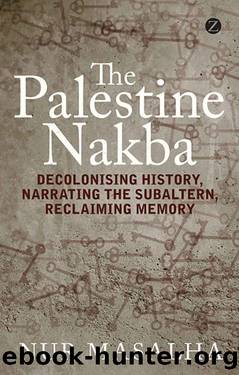
Author:Nur Masalha [Masalha, Nur]
Language: eng
Format: epub
Publisher: Bloomsbury Publishing
Published: 2012-08-08T18:30:00+00:00
âNew Historyâ and the Liberal Coloniser: Khirbet Khizâah and Zionist Narratives
In May 1949 the Hebrew novella Khirbet Khizâah was published by S. Yizhar (real name Yizhar Smilansky, 1916â2006), an army officer during the 1948 war.9 Khirbet Khizâah came out around the same time Arab historian Constantine Zurayk published in Arabic Maâna al-Nakba (The Meaning of the Nakba) (1949, 1956). Khirbet Khizâah was never translated into Arabic and Maâna al-Nakba was never published in Hebrew. Four decades later, in the late 1980s when the ânew historiansâ began writing about 1948, Yizhar declared himself âthe man who had [in 1949] laid bare the original sin of the State of Israel (Shapira 2000: 1â62, 2007: 81â123).
In May 1949, in contrast to the almost total obliviousness and forgetfulness of today (see Noga Kadmanâs study Erased from Space and Consciousness [2008], discussed below), few ânew Israelisâ were unaware that hundreds of Palestinian villages had been forcibly depopulated and destroyed by their army. Israeli historian Anita Shapira has shown that the veracity of the story of Khirbet Khizâah, widely discussed in Hebrew in the early 1950s, was never internally questioned or challenged at the time. The ânew historiansâ, when they began to publish findings from research in previously classified archives, also sought to remind Israelis of what they had forgotten from the mid-1950s onwards. Although Zionist atrocities in 1948 were widely known in Israel in the early 1950s, they were subsequently suppressed and rendered unknowable for the vast majority of Israeli Jews. Writing in 2006, ânew historianâ Ilan Pappé observed:
educators, historians, novelists, and cultural producers in general have all been involved in a campaign of denial and concealment. The horrors of 1948 were hidden from the public eye and from generations to come by those who committed them. Only at the end of 2000 did Gideon Levy,10 a voice in the wilderness, cry out in an article in Haaretz: How could you have lied to us for so many years? Very few ask this question now, and even fewer are willing to answer it. (2006: 287â8)
Khirbet Khizâah describes the expulsion of Palestinians from their village by the Israeli army, putting onto trucks those who did not evacuate their village, including the old and the sick who were unable to flee before the arrival of Israeli troops. Written in the immediate aftermath of the 1948 war, Khirbet Khizâah is a poignant account, fictionalised but recognisably partly autobiographical, of the ethnic cleansing of a fictional Palestinian village of that name. In 1949â51 the book generated a degree of public debate in Israel (Shapira 2007: 88â96). In Arabic the word khirbeh means literally âruinsâ, but in the local Palestinian dialect, notwithstanding Israeli and Hebrew usage, it means simply a relatively new small village established by several families that move out of a large mother village.11 However, according to Ronit Lentin, the Hebrew novella was not named Khirbet Khizâah (The Ruins of Khizâah) incidentally: â[T]he story is replete with love for the landscape and contempt for its Palestinian inhabitantsâ (Lentin 2010: 58).
Download
This site does not store any files on its server. We only index and link to content provided by other sites. Please contact the content providers to delete copyright contents if any and email us, we'll remove relevant links or contents immediately.
| Arms Control | Diplomacy |
| Security | Trades & Tariffs |
| Treaties | African |
| Asian | Australian & Oceanian |
| Canadian | Caribbean & Latin American |
| European | Middle Eastern |
| Russian & Former Soviet Union |
The Secret History by Donna Tartt(19086)
The Social Justice Warrior Handbook by Lisa De Pasquale(12190)
Thirteen Reasons Why by Jay Asher(8909)
This Is How You Lose Her by Junot Diaz(6886)
Weapons of Math Destruction by Cathy O'Neil(6279)
Zero to One by Peter Thiel(5801)
Beartown by Fredrik Backman(5754)
The Myth of the Strong Leader by Archie Brown(5507)
The Fire Next Time by James Baldwin(5442)
How Democracies Die by Steven Levitsky & Daniel Ziblatt(5218)
Promise Me, Dad by Joe Biden(5153)
Stone's Rules by Roger Stone(5087)
A Higher Loyalty: Truth, Lies, and Leadership by James Comey(4962)
100 Deadly Skills by Clint Emerson(4925)
Rise and Kill First by Ronen Bergman(4788)
Secrecy World by Jake Bernstein(4753)
The David Icke Guide to the Global Conspiracy (and how to end it) by David Icke(4717)
The Farm by Tom Rob Smith(4507)
The Doomsday Machine by Daniel Ellsberg(4490)
